
The door is usually the weakest link in the wall.
A wall can be built to almost any acoustic target. The door is what decides whether the room actually performs. We supply the whole assembly — leaf, frame, perimeter seals and automatic door bottom — because that is how a sound rating is measured.
Where acoustic doors matter
Sound isolation is rarely a comfort feature. In most projects it is written into a brand standard or a specification.
Hotels
A guest's first complaint is almost never the room. It is the corridor, the lift lobby, or the room next door.
Healthcare
Patient privacy is a regulatory requirement in most jurisdictions, and quiet supports recovery.
Education
Classroom acoustics are specified in ANSI/ASA S12.60, and the door is typically the limiting element.
Offices
Meeting rooms and boardrooms are judged on whether a conversation stays inside them.
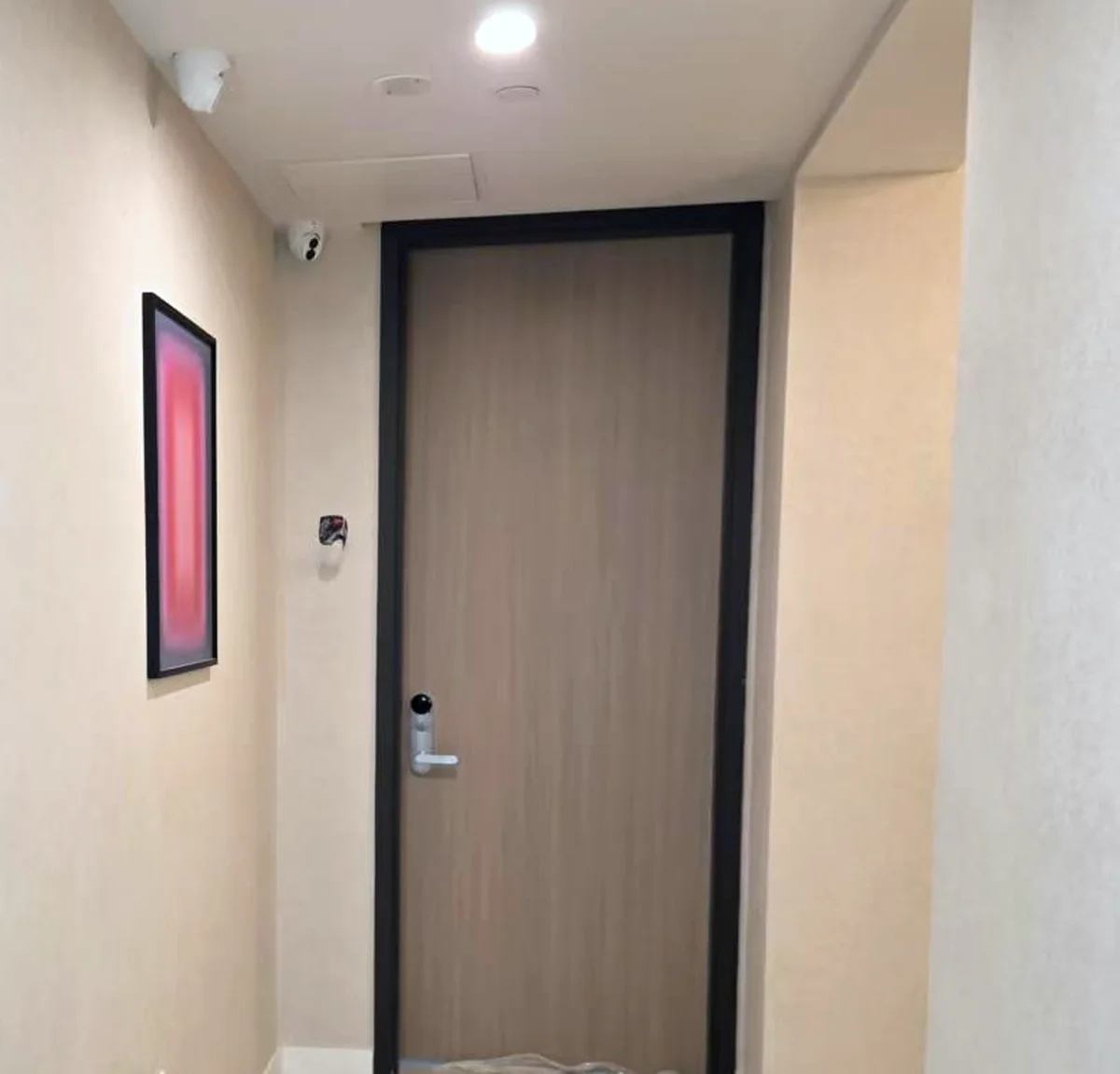
What a guestroom door actually has to do
This is the assembly a guest judges the room by, usually within the first minute. A timber leaf, a steel frame, an electronic lock — and a bottom seal that has to close onto carpet rather than a flat floor.
Each of those interfaces is a path for sound. The head gap, the jamb, the threshold and the leaf itself all have to be closed at the same time, and the seals have to survive being used several hundred times a year without being cleaned away by housekeeping.
A rating measured in a laboratory assumes all four are present. On site, one missing seal is usually the whole difference.
How loud is loud
Sound levels around us, and what a project is actually trying to separate.
Corridor conversation sits around 60–70 dB. A guestroom at night should sit near 30 dB. The door assembly carries most of that difference — which is why a specification names a rating rather than a material.
Typical targets in North American projects
What specifications commonly ask for, by room type.
| Application | Typical STC target |
|---|---|
| Hotel guestroom entry door | STC 30–35 |
| Hotel connecting doors (pair) | STC 40–45 |
| Meeting room / boardroom | STC 40–45 |
| Multifamily unit entry door | STC 28–32 |
| Classroom door | STC 30+ |
| Patient / exam room door | STC 30–35 |
Targets vary by brand standard and project specification. Reference frameworks include hotel brand design standards, ANSI/ASA S12.60 for classrooms and the FGI Guidelines for healthcare. These are typical specification ranges, not code minimums.
What STC actually measures
One number, measured on the whole operable assembly — not on the leaf alone.
STC (Sound Transmission Class) is the North American single-number rating for airborne sound isolation. It is measured to ASTM E90 and rated to ASTM E413, weighting the speech frequency range of 125–4,000 Hz — voices, television, music.
The rating belongs to the assembly: door leaf, frame, perimeter seals and door bottom together. The same leaf in a different frame, or with an incomplete seal set, can lose ten points or more once installed. That is why every rating we quote is an assembly rating, and why we supply the seals with the door rather than leaving them to be sourced on site.
What a rating sounds like
| Rating | What you hear from the other side |
|---|---|
| STC 25 | Normal speech clearly understood |
| STC 30 | Normal speech audible; loud speech intelligible |
| STC 35 | Loud speech audible but mostly unintelligible |
| STC 40 | Loud speech heard only faintly |
| STC 45 | Loud speech barely audible |
| STC 50 | Only very loud sound — shouting, bass — faintly heard |
How the test runs
- Source roomA calibrated loudspeaker plays broadband sound on one side of the assembly.
- Receiving roomA microphone measures what passes through, across the full frequency range.
- RatingThe transmission loss curve is converted to a single STC number per ASTM E413.
Field results (FSTC) typically run 5–7 dB below laboratory values because of flanking paths, wall junctions and installation variables. A laboratory rating is a ceiling, not a promise.
Where the sound gets through
A section through the head of a doorset. Four paths, four seals — miss one and the rating is theoretical.
Most acoustic failures we see are not the leaf. They are a head gap that was never sealed, a jamb seal that was specified but not fitted, or a threshold with no drop seal — all of which the laboratory result assumed would be there.
Fire and sound, one assembly
Most acoustic doors are specified on projects that also require a fire rating. Getting both from one tested assembly avoids the conflict that appears when two suppliers are involved.
Fire rating
Doorsets tested to UL 10C / NFPA 252 through Intertek, with WH certification. Ratings from 20 to 180 minutes depending on construction.
Acoustic package
Perimeter seals, intumescent strips and an automatic door bottom configured for the assembly rather than added to it.
One supplier
Leaf, frame, hardware and seals from one factory. When something does not fit, there is one party to call.
Tell us the STC target and the fire rating on the door schedule. We will come back with the assembly configuration, the test evidence available for it, and the limits of what has actually been tested.
Send your door schedule — we will return configurations opening by opening.
Request a quote